
The Age-Verified Panopticon
From D.C. to Montana, “Protect the Kids” Is the New Excuse for Total Surveillance

While Epstein’s buyers walk free, the FTC and states like Montana are forcing age verification that kills online anonymity, builds a tracking grid, and calls it “child protection.”
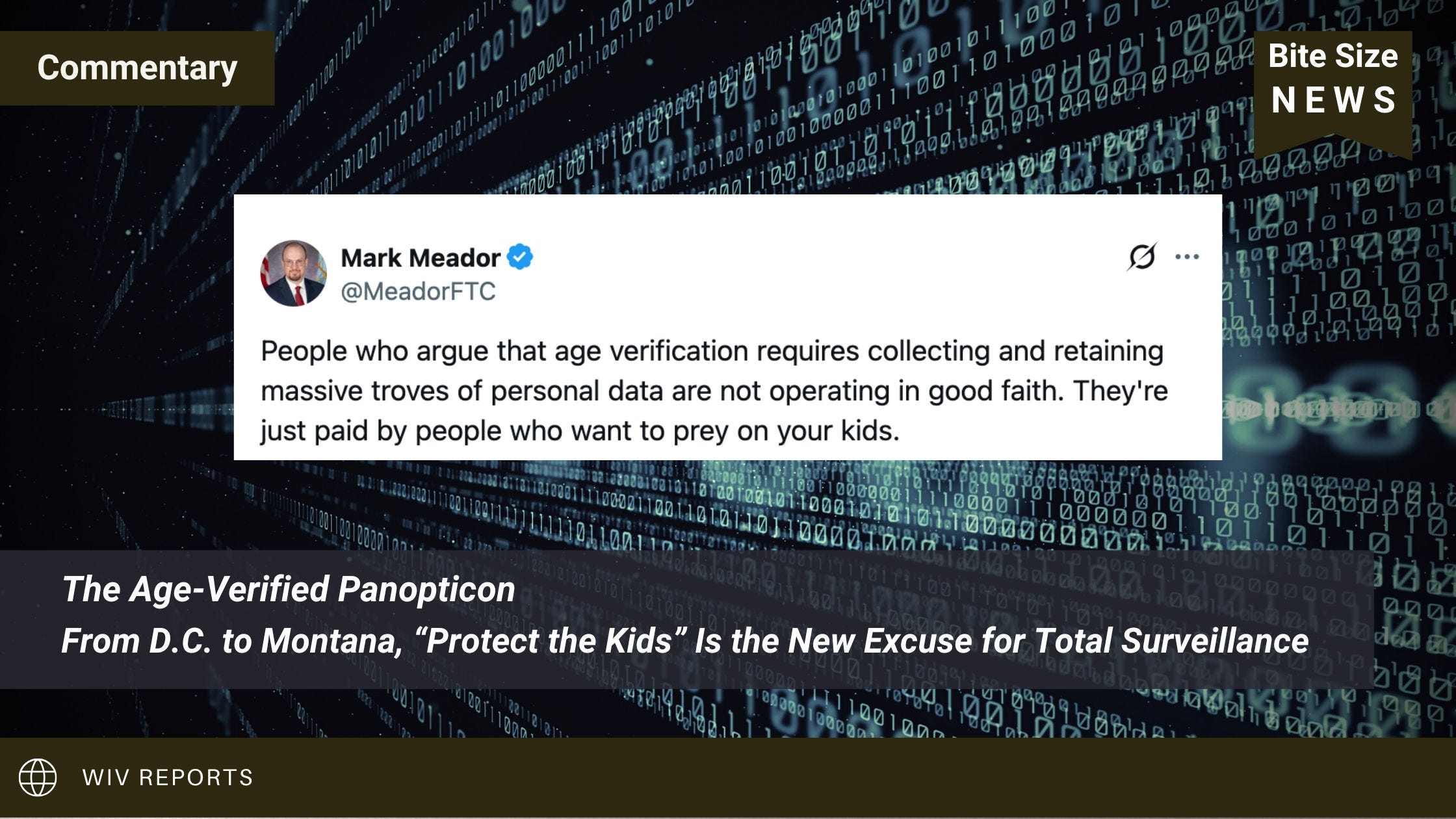
The same government that can’t “find” the men and women who bought children through Jeffery Epstein now wants the power to check your ID every time you go online “for the kids.” That’s not child protection. That’s scaffolding for a control system.
On March 5, FTC Commissioner Mark Meador posted that anyone warning that age verification will require massive data collection “is not operating in good faith” and is “paid by people who want to prey on your kids.” When a federal official says that out loud, you’re hearing the party line: smear critics as predators’ allies, deny the obvious surveillance risk, and rush the architecture in before people realize what it really does.
Meador is not some rogue bureaucrat. He’s the polished salesman for a bipartisan project to weld identity, speech, and access to information into one stack sold as safety, enforced as obedience.
What Meador Is Actually Selling
In January, Meador headlined an FTC “Age Verification Workshop” in D.C., framing age checks as no different from carding someone at a liquor store. He went out of his way to reject the idea that this is about censorship or authoritarianism, calling third‑party verification an “elegant” and “efficient” solution that will supposedly let kids be safe while adults stay free.
Right after that, the FTC issued a COPPA enforcement policy that does one thing clearly: it encourages companies to adopt age‑verification technologies and signals that the agency will treat those tools favorably. Law firms advising corporate clients got the message immediately. They’re already telling companies that the FTC wants age verification to “mature” and that aligning with Meador’s vision is the safe play.
Notice what isn’t happening. There’s no serious push for hard limits on data retention, no real federal privacy law with teeth, no crackdown on ad‑tech surveillance. Instead of dismantling the data‑harvesting economy, they’re standardizing it and slapping a “for the children” sticker on the front.
The Core Lie: “This Doesn’t Require Massive Data”
Meador’s tweet rests on a lie: that you can roll out age verification across the modern internet without building systems that either collect or tightly infer personal data on everyone. Every real-world implementation says the opposite.
Montana is a perfect example. SB 544, passed in 2023, forces adult websites to deploy “reasonable age verification” if more than one‑third of their content is deemed harmful to minors. The options in practice are government ID uploads, credit‑card and transaction checks, third‑party age‑verification services, or biometric tools like facial recognition tied to identity documents.
You don’t get that menu without “massive troves of personal data.” You either collect it directly: copies of IDs, card data, face scans, or you lean on companies whose entire business model is aggregating and selling that data. Pretending the FTC has clean hands because the state uses “commercial providers” is a joke. The data still exists, the link between your identity and your online behavior still exists, and the subpoena path to that data still exists.
Civil-liberties groups looking at KOSA and similar federal bills have already warned that the structure of these laws effectively forces platforms to verify age if they want to avoid getting crushed over “harms to minors.” In the real world, that means every user, adult or minor, faces a simple choice: hand over enough information to be classified, or be blocked. Some of that will be explicit ID checks. Some will be “age estimation” based on biometrics and behavior. All of it is surveillance‑heavy and hostile to anonymity.
When Meador claims critics are lying about the data problem, he’s trying to keep people from looking under the hood.
Montana as a Testbed
For you in Billings, this isn’t hypothetical. SB 544 is already law. Pornhub decided it would rather block access in Montana than become an unpaid data‑collection front for the state’s moral panic. Other sites have faced the same choice: either plug into verification services and absorb the cost and liability, or wall off the entire state.
The result is simple. Adults in Montana are being pushed toward ID‑gated access for legal content, or they’re just cut off. Website owners are turned into reluctant gatekeepers. The standard of “harmful to minors” is broad and political enough that it can easily expand beyond porn into whatever future lawmakers decide is dangerous.
This is exactly how you build a culture where anonymous access looks suspicious by default. You don’t ban anonymity outright. You just make the “responsible,” legally safe option require an ID at the door, and let the rest wither.
The Age-Verified Internet vs. Real Justice
Step back and compare the intensity here to what we’ve seen with Epstein.
We had a long‑running child‑exploitation and trafficking operation serving wealthy and connected men. We know names exist. We know institutions: banks, intelligence agencies, and law enforcement had visibility into the network for years. Yet there is no nationwide campaign to unseal everything, hunt down every buyer, and burn the network to the ground.
Instead, Congress spends its political capital on age‑gating the internet. The FTC holds workshops to help industry refine verification tech. Lawmakers pass state laws like SB 544. Lobbyists and “child safety” NGOs get funding. Big platforms get a new compliance market and a flood of verified, higher‑value identity data.
Ordinary people get scanned, logged, and restricted, while the people who could be prosecuted for buying kids keep their privacy. That tells you what really matters to this system.
What Pushback Has to Look Like
If you care about kids and you care about freedom, you can’t let them hide this behind culture‑war noise.
The lines are straightforward:
We should not have mandatory age verification to access lawful speech and information. We should not let the FTC turn COPPA into a battering ram for age‑verification vendors. We should be demanding real privacy law and real enforcement against traffickers, not new pipes for our data to flow through.
And every time someone like Mark Meador waves the “think of the children” flag while calling critics grifters for predators, remember: this isn’t about porn. It’s about building an ID checkpoint into every meaningful corner of the internet, then letting the next administration, and the next, decide how hard to squeeze.
The system that couldn’t be bothered to tear through the Epstein client list has suddenly discovered an unlimited appetite for “protecting kids” by tracking you. Believe what they do, not what they tweet.
WIV Reports - Political Analysis
Following the money while others follow the narrative